

IONFRESHER®
3 in 1 Air Purifier
5V USB to
High-Voltage Plasma Ionization
Truly Consumable-Free
Protecting the air closest to your breathing zone
Plasma Sterilization × Electrostatic Dust Collection × Negative Ion Purification = IONFRESHER®
🔥 No HEPA Filter Replacement | No Activated Carbon Replacement | No UV Lamp Replacement | No Fan Noise
Made in Taiwan
with 40+ years of export electronics manufacturing experience
What Is a Personal Air Purification Shield

Not a mask. Not a face shield. Not a whole-room air purifier.
A Personal Air Purification Shield is a new approach designed for continuous small-area air treatment around your breathing zone.
Current air protection methods generally fall into two categories. One is masks or face shields, which provide personal protection when worn. The other is air purification equipment, which improves indoor air conditions by treating the overall space.
Both approaches are important. Masks and face shields provide direct close-range protection, while space-based air purification equipment helps improve overall indoor air quality and reduce the buildup of pollutants in the environment.
However, in real indoor environments, both approaches have their limits.
Masks and face shields can provide protection, but they must be worn for long periods of time, which may cause heat, pressure, unnatural speech, and inconvenience during interaction.
Space-based air purification equipment can improve overall air quality, but it may not always be able to consistently protect the small area of air closest to each person’s breathing zone.
This is because real indoor air is always moving, mixing, and changing. Human movement, speaking, opening doors, air conditioner airflow, fan disturbance, and even people passing by can continuously affect the air around the body.
Even when the overall space is being treated, the personal breathing zone may still be repeatedly affected by surrounding airflow, dust, odors, airborne pollutants, and nearby activity.
Especially in open indoor environments, there are more people, more airflow disturbance, and more complex air sources. In most cases, individuals also cannot control the overall conditions of the space.
In this kind of situation, if a close-range air treatment point can be created near the user and can continue operating over time, the overall air protection approach becomes more complete.
For this reason, we define a new type of air treatment approach that stays closer to the user’s breathing position, works continuously within a fixed small area, and does not require anything to be worn on the body for long periods of time: the Personal Air Purification Shield.
It is not meant to replace masks, face shields, or space-based air purification equipment. Instead, it is designed to fill the close-range breathing zone that has not been fully covered by either approach, allowing personal barrier protection, close-range purification, and whole-space air treatment to work together as a more complete protection system.
Two Core Conditions

A product does not become a Personal Air Purification Shield simply by being small or placed nearby.
It must meet both the air-treatment conditions and the personal-use conditions at the same time.
A Personal Air Purification Shield is not defined simply by compact size or by being placed near the user. Its true value depends on whether it meets two essential conditions at the same time.
First, it must meet the air-treatment conditions by actively treating the air around the breathing zone. Second, it must meet the personal-use conditions by being suitable for long-term use in close proximity to the user.
Only when both of these conditions are met can it truly become a Personal Air Purification Shield that continuously protects the air closest to the breathing zone.
Air-Treatment Conditions
These elements describe how the air around the breathing zone should be actively treated.
-
Air Sterilization
Helps reduce airborne contaminants
-
Dust Collection
Collects dust and fine particles
-
Particle Settlement
Helps particles settle from the air
Personal-Use Conditions
These elements describe whether the product is truly suitable for close-range daily use.
-
Quiet Operation
Designed for low-noise use
-
USB Power
Uses simple USB power
-
Portability
Easy to place and carry
Only when both are present can it truly function as a Personal Air Purification Shield that protects the air closest to the breathing zone.
Why Plasma Ionization Fits Best
A Personal Air Purification Shield cannot rely on a single air-treatment function.
It must respond to multiple air-treatment needs around the breathing zone at the same time.

When a product is defined as a Personal Air Purification Shield, the real question is not whether it offers just one specific function. What truly matters is whether the core technology behind it is strong enough to support the full air-treatment role that this concept requires.
The reason is simple.
A Personal Air Purification Shield is not designed to deal with only one air problem. It must be able to respond to multiple air-treatment needs around the breathing zone at the same time. If a technology can perform only a single function, then even if the product is compact and placed close to the user, it still cannot truly fulfill the role and value that a Personal Air Purification Shield is meant to provide.
Plasma ionization stands out because it does not need to awkwardly rely on several separate technologies pieced together. Instead, within one unified technical framework, it can simultaneously deliver three air-treatment effects: plasma sterilization, electrostatic dust collection, and negative ion purification.
This means it is no longer just a single-function air-treatment method. It is closer to an integrated air-treatment approach that can respond to multiple needs at the same time.
For a Personal Air Purification Shield, this kind of integration is not merely an added benefit, nor just an extra functional advantage. It is a key factor in determining whether the technical direction is truly appropriate and whether it is genuinely suitable for close-range use around the breathing zone.
For this reason, among many air-treatment technologies, plasma ionization is more appropriately regarded as one of the core technical directions for Personal Air Purification Shields.
Should You Worry About Ozone?

Plasma ionization can generate trace ozone during operation.
What matters is not whether ozone exists, but whether it is kept within a low and reasonable range.
Plasma ionization can generate trace ozone during operation. This is a known byproduct of the ionization process. What truly matters is not whether ozone exists at all, but whether it can be kept within a low and reasonable level so that a high ozone concentration does not form.
High ozone concentration is usually clearly pungent and accompanied by a strong electrical smell. Trace ozone, by contrast, may be perceived by some people as a very light after-thunderstorm air smell, while others may notice almost nothing or not detect it at all.
For this reason, the key issue is not the mere presence of ozone, but whether the product is designed and controlled to avoid excessive ozone formation during normal operation. California’s air-cleaner rule sets an ozone emission limit of 0.050 ppm (50 ppb) for applicable indoor air cleaners, and U.S. FDA labeling requirements for certain ozone-generating medical devices also reference less than 0.05 ppm.
At the testing and certification level, related references in this product category commonly include CARB for air-cleaner ozone emission limits, UL Solutions for ozone-related validation pathways such as UL 2998, EPA guidance on ozone-generating air cleaners, and WHO ozone air-quality guidelines. Third-party laboratories and certification organizations such as Intertek and TÜV Rheinland also provide air-cleaner testing against ozone-emission and regulatory requirements, while AHAM Verifide notes that certified room air cleaners are independently tested and references CARB ozone limits.
In short, the real question is not “Does plasma ionization generate ozone?” The real question is whether that ozone is kept low, controlled, and reasonable during actual operation.
Point, Line, and Area Protection
Starts with one protection point
Extends along daily movement paths
Expands across real-life spaces
Builds into a broader protection network
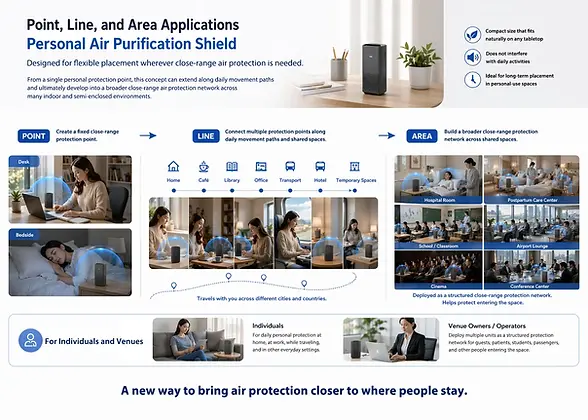
The value of a Personal Air Purification Shield lies not only in close-range air treatment at a single location, but also in its ability to expand into a wide range of real-world applications.
When a device is placed at a desk, bedside, beside a sofa, dining table, office seat, clinic seat, or any other place where people remain for extended periods, it first creates a fixed close-range air treatment point. This is the concept of a “point,” and it is the most basic starting point of a Personal Air Purification Shield.
A “point” does not have to exist only in a fixed private setting. It can also move with the user into temporary or semi-fixed environments such as cafés, libraries, hospitals, rental rooms, hotels, motels, transportation seating, camper vans, camping tents, and many other places where people stay for a period of time. It can even travel with the user across different cities and countries.
In this sense, the value of a Personal Air Purification Shield is not limited to one room or one routine, but can extend into real daily movement, temporary stays, and mobile living environments.
When multiple stay points are arranged according to daily movement paths, seating distribution, and actual needs, these points can gradually connect into a “line.” When multiple lines expand across a larger area, they form an “area.”
At this stage, the concept is no longer limited to personal placement alone. In hospital rooms, postpartum care centers, infant care centers, schools, kindergartens, tutoring centers, cinemas, airports, concert halls, conference centers, waiting areas, lounges, and other high-occupancy indoor environments, venue owners or space operators can deploy multiple units as a structured close-range protection network to help protect anyone entering the space.
This means that a Personal Air Purification Shield is not limited to a single product, a single seat, or a single location. It can begin from one personal stay point, extend along daily movement paths, and ultimately develop into a broader close-range air protection concept across many different types of indoor and semi-enclosed environments.
It also means that this concept can serve not only individual users who purchase a unit for their own daily protection, but also venue owners and operators who deploy multiple units as a structured protection network for guests, patients, students, passengers, or other people entering the space.